




One of the things I truly miss as a Mexican living abroad is the chance to celebrate special days with my family. Over the years, I’ve brought these traditions to my little family in London. While I may not be able to be with my mum and siblings, my children and my husband have embraced our celebrations wholeheartedly.
For us, the most meaningful time of the year is Día de Muertos — Day of the Dead. This day holds a special place in our hearts because it is when we remember my dad, celebrate his life, and honor all those we have loved and lost. Setting up the ofrenda (altar) together has become a beloved family tradition, and on the actual day, we enjoy a wonderful feast featuring all the foods my dad used to love. Sometimes we invite friends over, and it turns into a joyous gathering. But if I’m honest, the moment my children most look forward to is making Pan de Muerto.
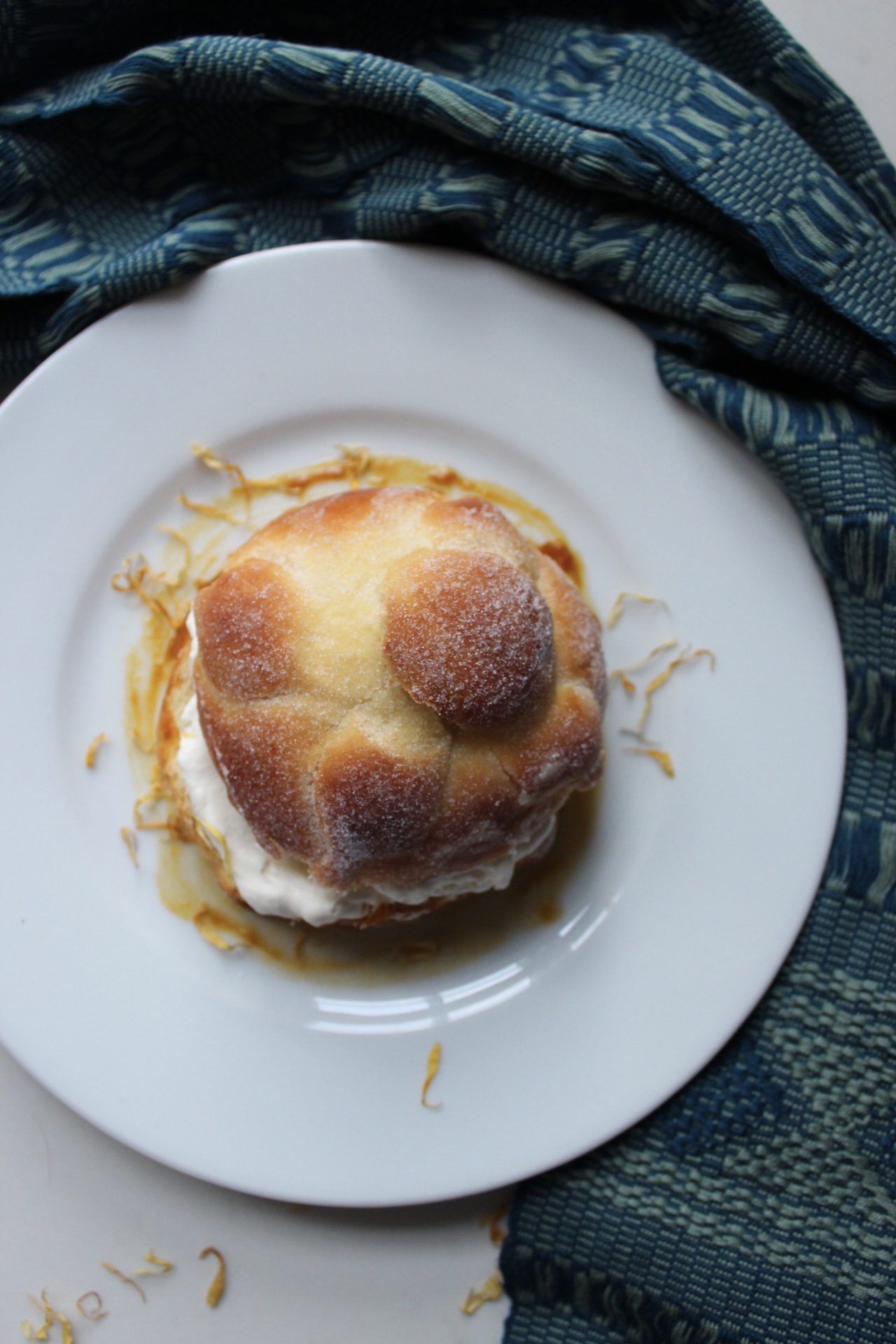
This sweet, aromatic bread is the star of Día de Muertos. Its fragrance fills the house and brings such warmth and joy. My children love it so much that I often bake it several times before November 2nd. Seeing their faces light up when they come home from school and smell the scent of freshly baked Pan de Muerto is one of those magical family moments I hope to keep alive for many years. These are Mexican food memories that I know will stay in their hearts forever.
Table of Contents
- Introduction – Why Pan de Muerto is Special
- The History and Significance of Pan de Muerto
- Why You’ll Love This Recipe
- What You Will Need – Ingredient Guide
- How to Make the Best Pan de Muerto
- Instructions
- Tips for Perfect Pan de Muerto
- FAQs – Common Questions Answered
- Serving Suggestions
The History and Significance of Pan de Muerto
Pan de Muerto is more than just a sweet bread — it is a symbol, a memory, and a link between the living and the departed. Its origins trace back to pre-Columbian times, when indigenous peoples held month-long celebrations honoring the dead. When the Spanish arrived, these traditions merged with Catholic beliefs, giving rise to the modern Día de Muertoscelebrations.
Each element of Pan de Muerto has symbolic meaning:
- The round shape represents the cycle of life and death.
- The four dough strips across the top symbolize bones.
- The small ball on top represents the soul or spirit of the deceased.
- A light brushing of orange blossom water infuses the bread with a delicate floral fragrance, associated with remembrance and purification.
Across Mexico, Pan de Muerto varies regionally:
- Classic Pan de Muerto: Round with bone-shaped decorations and sugar coating.
- Figured Pan de Muerto: Shaped like animals such as rabbits or birds, representing life and fertility.
- Oaxacan Pan de Muerto: Flavored with anise seeds, sometimes filled with piloncillo or chocolate.
- Glazed or Sugar-Covered Pan de Muerto: In Mexico City, brushed with butter and coated in sugar for extra sweetness.
- Stuffed Pan de Muerto: Filled with cream, jam, or chocolate for a modern twist.
No matter the type, Pan de Muerto is always a bread of memory, celebration, and family. Baking it yourself connects you to centuries of tradition, and sharing it creates lasting memories for your loved ones.
Why You’ll Love This Recipe
- Family-Friendly: Baking Pan de Muerto is a great activity for kids and adults alike.
- Tradition Meets Flavor: Combines authentic Mexican tradition with a delicious, buttery, aromatic bread.
- Perfect for Celebrations: Ideal for Día de Muertos, but also for breakfast, brunch, or any special occasion.
- Versatile: Can be eaten plain, with hot chocolate, or with spreads.
- Satisfying and Rewarding: The smell alone fills your home with warmth and nostalgia.
What You Will Need – Ingredient Guide
To make a truly authentic Pan de Muerto, it’s important to understand the ingredients and what each brings to the bread:
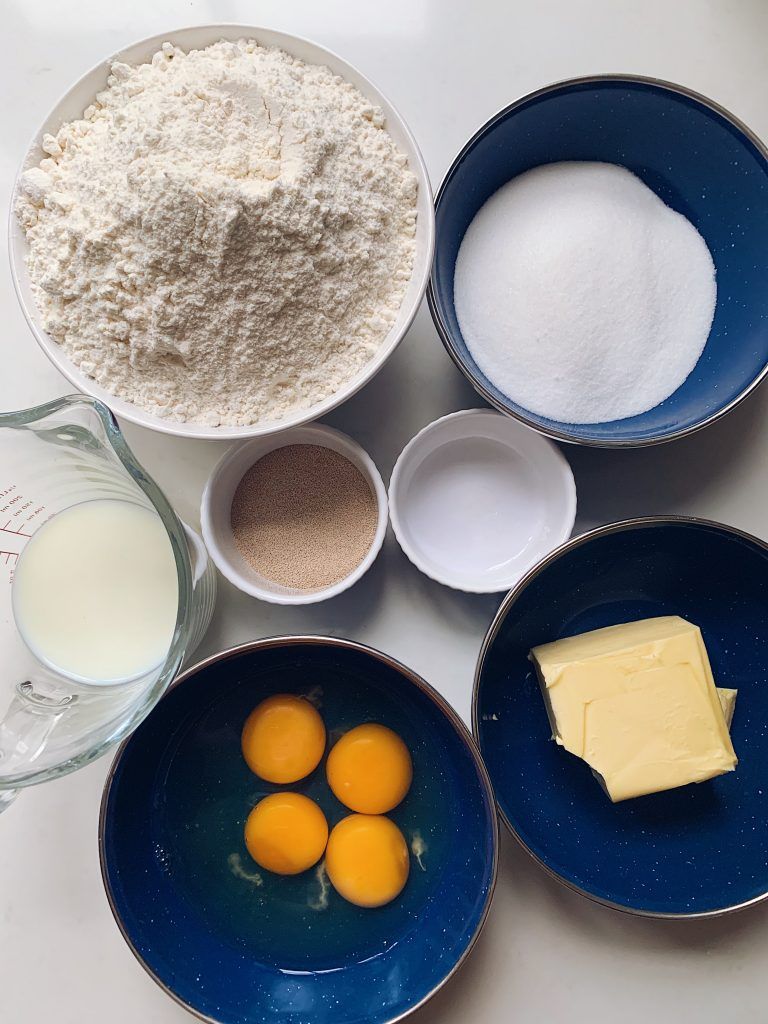
- All-Purpose Flour: The foundation of the dough, providing structure and body. Fresh flour ensures a soft, tender crumb and a light texture.
- Sugar: Sweetens the bread just enough to balance the flavors, without overpowering the delicate floral notes of orange blossom water. Sugar also helps activate the yeast, giving the dough a better rise.
- Unsalted Butter: Adds richness, tenderness, and flavor. Incorporating soft butter creates a soft, melt-in-your-mouth crumb that is essential for Pan de Muerto.
- Yeast: The magic ingredient that makes the bread rise, creating its characteristic airy texture. Using fresh yeast adds a more traditional flavor, while instant yeast is a convenient alternative.
- Milk: Moisturizes the dough and helps create a soft, fluffy texture. Warm milk also helps activate the yeast for a better proof.
- Eggs: Provide structure, richness, and natural color. Eggs also contribute to the bread’s tender, light texture.
- Orange Blossom Water: A signature ingredient for Pan de Muerto, giving it that delicate floral aroma that instantly evokes Día de Muertos.
- Orange Zest: Adds brightness and a subtle citrus flavor, perfectly balancing the sweetness of the bread.
For Brushing and Finishing:
- Egg and Milk Wash: Creates a shiny, golden crust and enhances the visual appeal of the bread.
- Butter and Sugar Coating: Brushed on while warm, the butter helps the sugar adhere and adds richness, while the sugar gives the bread its classic sweet finish.
How to Make the Best Pan de Muerto
Sugar coating: Brush warm breads with melted butter and coat generously with caster sugar, shaking off any excess.
Use room temperature ingredients: Eggs and butter should sit at room temperature for several hours to ensure a smooth, elastic dough.
Activate your yeast properly: Use warm milk (not hot) and a pinch of sugar. Wait until it’s bubbly before adding to the dough.
Knead thoroughly: Work the dough until it’s smooth and slightly tacky, either by hand (~15 min) or with a stand mixer (~10 min).
Proof in a warm spot: First proofing is key — the dough should double in size.
Shape carefully: Use small dough pieces to form the “bones” and “head.” Use a little water to attach them.
Second proofing: Allow the shaped breads to rise again until doubled. This ensures a soft interior.
Egg wash for golden color: Brush with egg and milk before baking.
Tips for Perfect Pan de Muerto
- Ensure a warm proofing environment for fluffy bread.
- Don’t skip the second proofing — it makes the bread light and airy.
- Use fresh yeast if possible for optimal flavor.
- Handle dough gently when shaping bones to keep bread soft.
FAQs – Common Questions Answered
Q: Can I use instant yeast instead of fresh yeast?
A: Yes, the flavor will be slightly different but still delicious.
Q: How long does Pan de Muerto stay fresh?
A: Best eaten within 2–3 days, but can be stored in an airtight container for up to a week.
Q: Can I freeze the bread?
A: Yes, fully cooled bread can be frozen for up to 1 month. Thaw at room temperature and refresh in the oven for a few minutes.
Q: Can I add flavors like chocolate or anise?
A: Absolutely! Some regions in Mexico add anise seeds, chocolate, or piloncillo for a twist.
Q: What’s the best way to serve Pan de Muerto?
A: Warm with hot chocolate or café de olla, or as part of your altar offerings.
Serving Suggestions
- Serve with hot Mexican chocolate or café de olla.
- Include as part of your altar offerings for Día de Muertos.
- Pair with fruit, sweet spreads, or cinnamon for a modern twist.
- They can also be enjoyed on a cozy morning or rainy afternoon to fill your home with warmth.
Ingredients
Equipment
Method
- Before start, remember to take your eggs and butter a few hours in advance so they are to room temperature.
- Start by mixing the yeast with the warm milk and one tea spoon of sugar. Leave to activate for 7 minutes. Until it has lots of bubbles.
- Mix the flour and the sugar. Place this mix on the worktop and make a whole in the middle. Beat the eggs and add the orange bloosom and orange zest. Pour this in the hole of the flour and sugar, then add the yeast and milk mixture and start mixing. Then add the butter.
- Mix all very well and work the dough until it doesnt stick on your hand. It might take around 15 minutes.If you have an electric mixer, this would speed this process, just add all the ingredients and turn the mixer in the lowest setting and mix for 10 minutes.
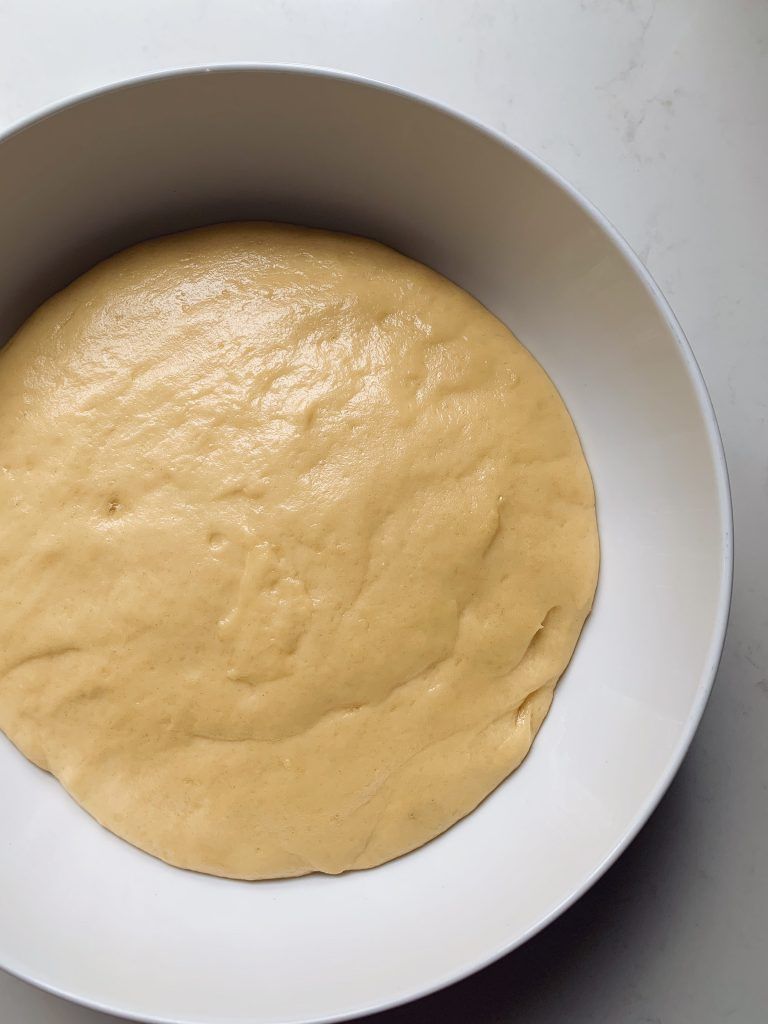
- Once your dough is ready, oil a large bowl and place your dough there and cover it with cling film and leave it in the warmest place of your kitchen. This is going to be the first proving of the bread. Prove for an hour or until the dough has double in size.
- Remove the cling film and hit it with your fist to. Take it out of the bowl and work it a bit more. Use some flour if it is sticking on the worktop. Then separate the dough into fifteen 70g balls.
- Have the baking trays ready with the parchment paper. Then cut the 70g ball into two, one 20 g ball for the bones and head and one 50 g for the body.
- Now, to make the Pan de Muerto, grab a 50g dough ball and roll it with one hand until form a smooth ball, place it on the baking tray. Do the same with the rest 50g balls.
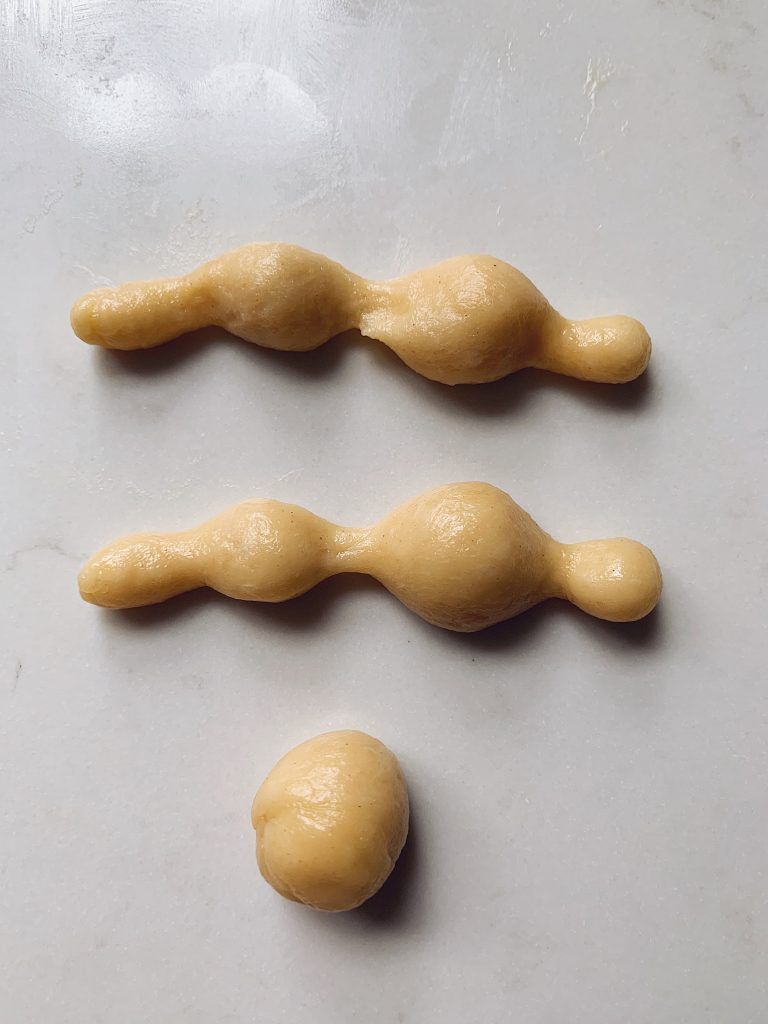
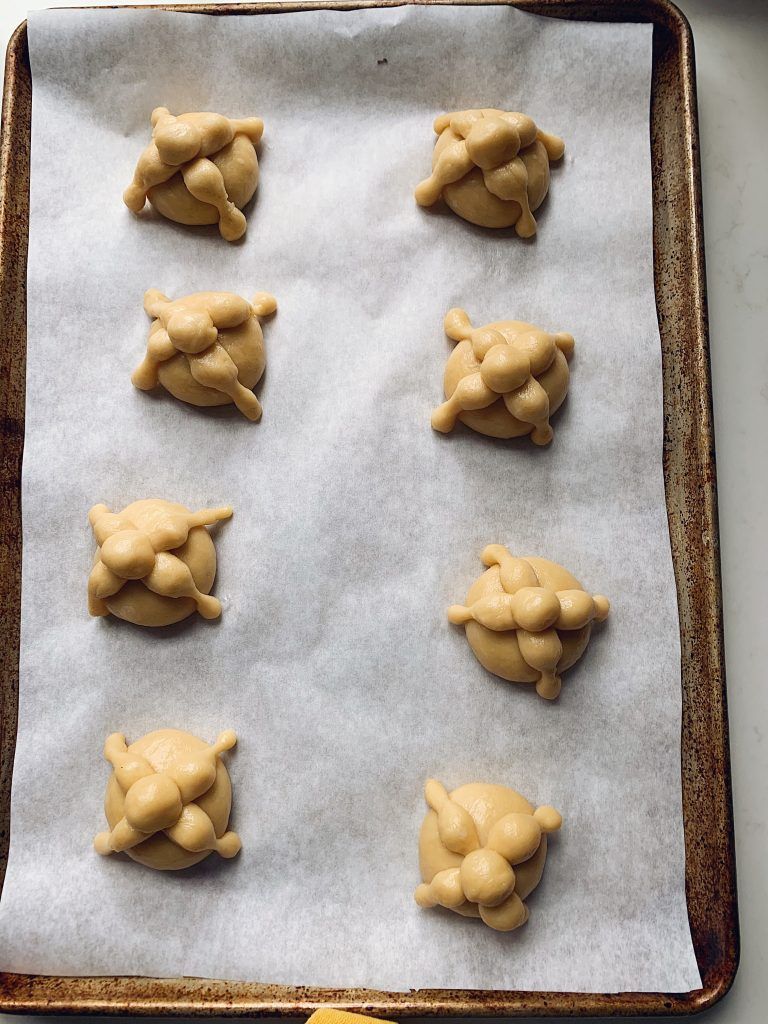
- Then cut the 20g dough ball into 3 to make the bones and the head (see pic below)
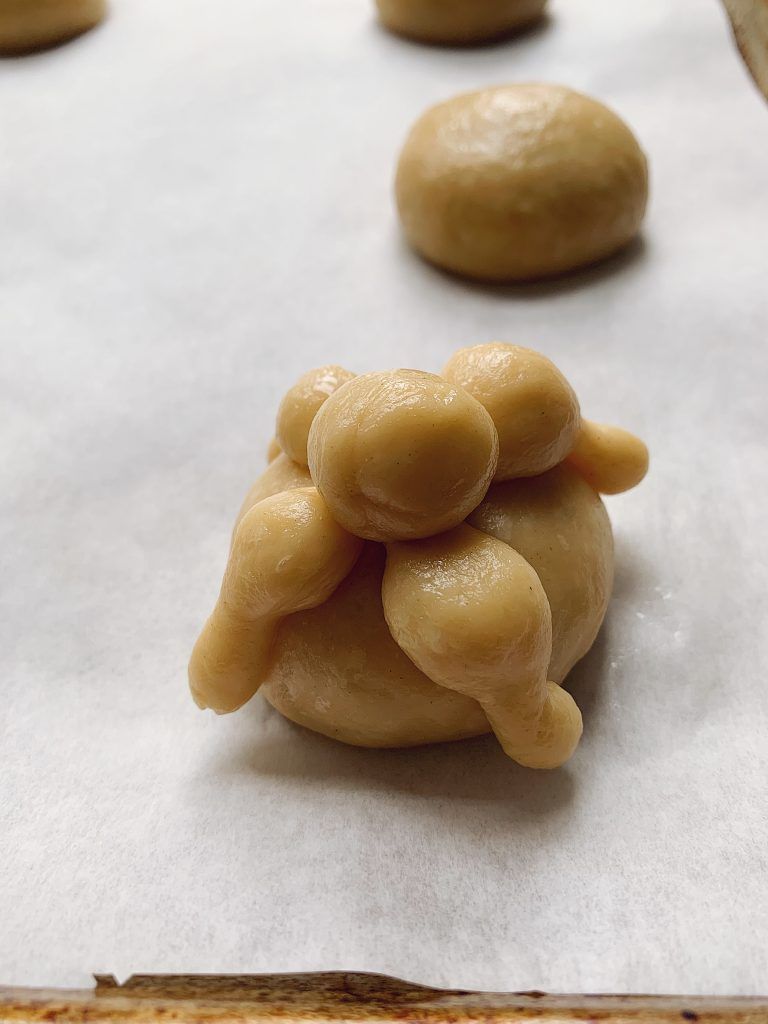
- To stick the bones and the head just add water with your finger. Then place the little pieces of dough (see pic below)
- Once they are all done, they need to rest again. They need to prove for one more hour or more dependig on the temperature of your kitchen. If you have an oven with proving setting that helps a lot.
- Once they have double in size, it is time to bake them. Preheat the oven to 170C. Mix the beaten egg and 2 tablespoon of milk and brush each bread with this mixture. Place them in the oven and bake for 15 to 20 min.
- Remove them from the oven and let them cool down for 5 minutes. Then while they are still a bit warm, brush them with melting butter and cover them with caster sugar, making sure to get rid of the excess of sugar.
- They can be eaten straight away and they make the best companion to a nice hot Mexican chocolote. Enjoy them with your family on a rainy day.
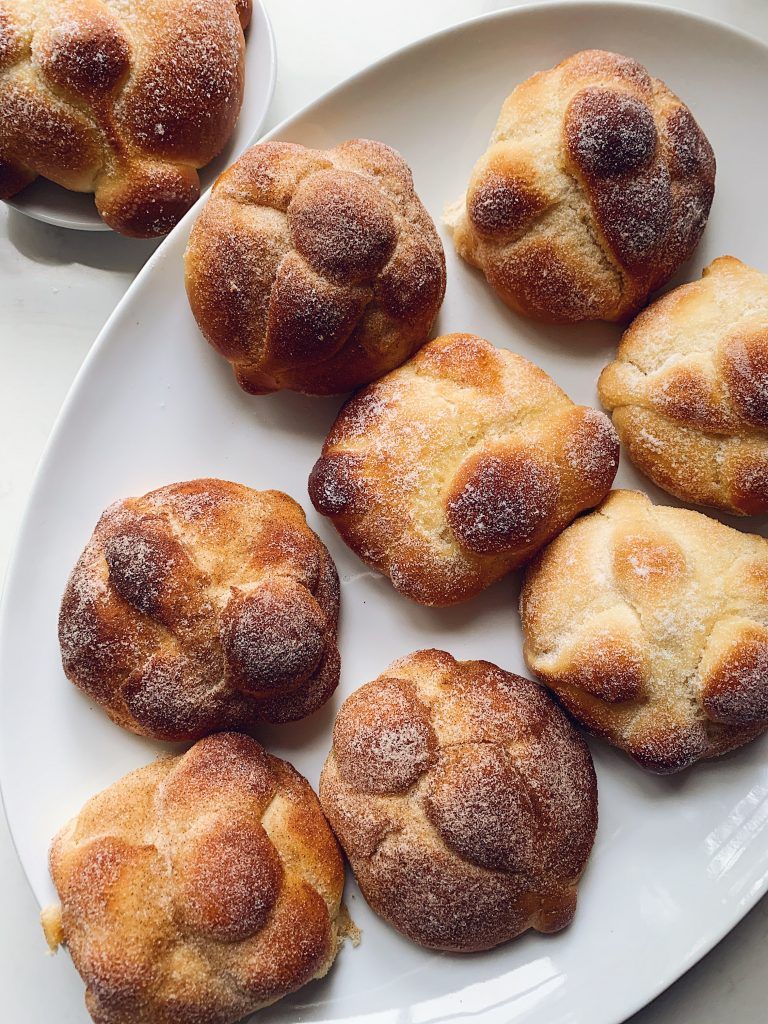
Baking Pan de Muerto is more than making bread, it’s about memory, tradition, and connection. It brings family together, fills the home with joy and aroma, and keeps Mexican culture alive even far from home. Enjoy it straight away, share it with loved ones, and let the flavors and fragrance fill your home with love, warmth, and joy.
Feliz Día de Muertos!
Love,
Karlita x



Anonymous says
Excellent recipe! Made into 8 larger Pan de Muertos and Mexican husband declared they were the best he’d had outside Chiapas. Our kitchen is half the temperature of a Mexican one so took 2 hours each time for dough to double in size but it was perfectly light and well worth waiting for. Made yesterday as a trial run before making 20 for our neighbours and friends. Had one for breakfast today- cut into slices and briefly toasted still tasted amazing! Dough is very sticky so needed a little extra flour when shaping and next batch I’ll double the amount of orange zest and orange blossom water to boost flavour (personal preference – your version is beautiful and delicately flavoured but my husbands mexican food memory is a stronger flavoured one in Tapachula) This is the easiest and best Pan de Muerto recipe I’ve used in last 20 years – usually spend all day using Diana Kennedy or Rick Bayliss ones. Thanks Karla for bringing us the best bits of Mexico!